What the Sea Cannot Take
Standing before Winslow Homer's painting, 'The Gulf Stream,' the author reflects on the sea's dual roles of refuge and peril. Through vivid imagery and personal narrative, the article delves into themes of survival, dignity, and the human spirit's resilience against the unknown. It is a poignant exploration of how the sea shapes lives and legacies.
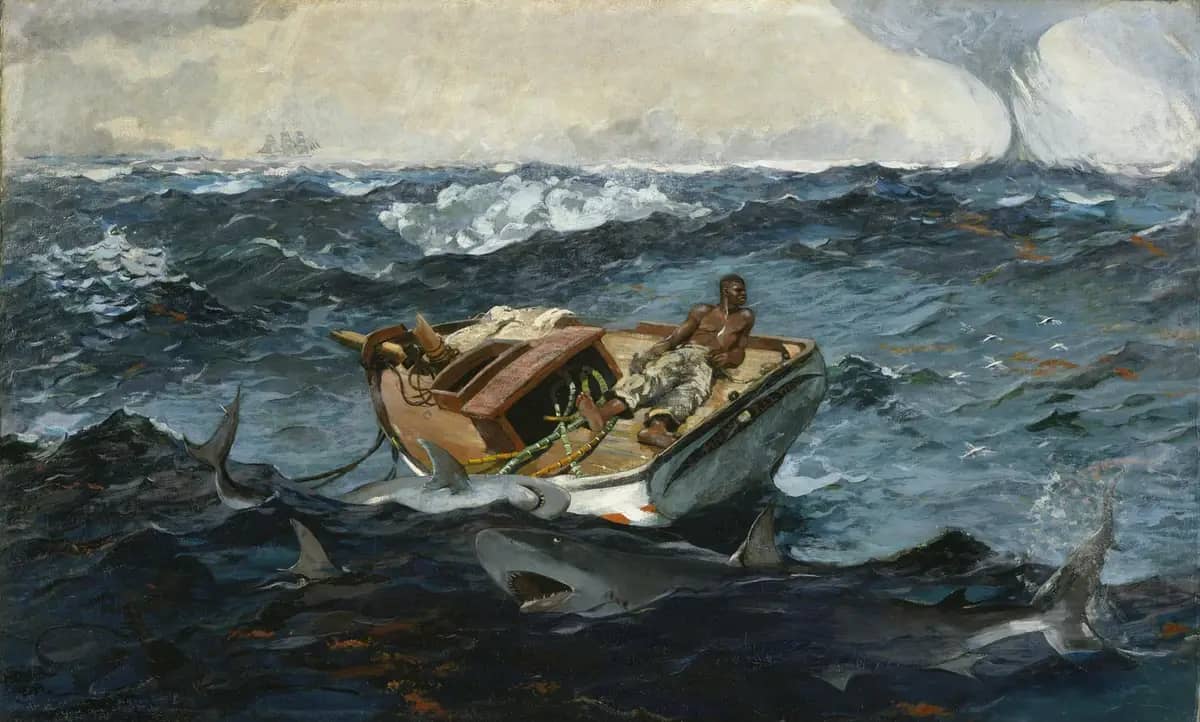
I stood in front of The Gulf Stream for almost twenty minutes, which is too long for a museum guard's patience and not nearly long enough for what the painting demands. Winslow Homer finished it in 1899, a man adrift in a broken boat, sharks gathering beneath him, a hurricane assembling itself on the horizon with no urgency at all, the unhurried patience of something that already knows how the story ends. I am Mediterranean. I grew up with the sea the way other people grow up with religion or grief, something always present, never fully explained. The sea was where my father took us when there was nothing left to say to each other. It was the edge of every city I loved, Algiers, Madrid, the horizon you measure your homesickness against without realising it. And it is also, for thousands of young Algerians who never got the chance to stand in a museum and call this contemplation, the last decision they ever made. The harraga boats leave at night so the coastguards won't see them, and the same sea that raised me as a child raises a different question for them. Refuge or grave, depending on the night, depending on the current, depending on nothing they control.
So when I stood in front of that canvas I was not looking at a stranger. I was looking at every man who has ever trusted the horizon more than the shore behind him.
Most people remember the sharks. They remember the broken mast, the dark water, the storm gathering itself in the distance. They remember the visible dangers because visible dangers are almost a comfort. They suggest survival is simply a matter of naming the threat correctly. What they forget is the man. He does not scream. He does not raise his hands toward whatever god might be watching. He sits in the wreck of his own boat with a posture that holds neither triumph nor despair, and that is the detail that has kept this painting alive for more than a century while louder shipwrecks have been forgotten. The subject is not the storm. The subject is a man who has run out of moves and has decided, with no one watching and no promise of rescue, that running out of moves is not the same thing as losing.
That posture is not resignation, and the difference matters more than it sounds. I learned the real version from men of my grandfather's generation, men who buried sons and decades and entire ways of life and still showed up at the café the next morning with their shirts pressed, their backs straight, their grief folded somewhere private. Dignity, for them, was never the belief that things would turn out well. It was the refusal to let the outcome decide how they carried themselves while waiting for it. Camus understood this without needing the sea to prove it. Somewhere in him there was always a man on a boat, rowing toward a shore that may or may not exist, refusing to let the absence of meaning excuse him from living anyway.
But there is a harder question underneath this one, and Homer was honest enough to leave it unanswered even when collectors asked him directly what became of his sailor. What happens to this man if the ship actually comes. Not if it doesn't. If it does.
There is a kind of person, and I suspect most of us have been him at some point without admitting it, who needs the storm more than he needs the rescue. Not because he enjoys suffering, but because the storm gives him a shape. It tells him where to put his hands, what to fear, what to fight, who he is in relation to the thing trying to kill him. Take the storm away and the shape disappears with it. A man who has spent years defining himself against scarcity, against exile, against an enemy or an illness or a country that wronged him, does not simply relax once the threat lifts. He goes looking for the next one, quietly, almost without noticing, because peace asks a question that danger never had to. Cioran wrote that we do not fear death so much as the absence of an obstacle worth dying against, and I think he had located something true about the architecture of the self. We are not built around comfort. We are built around resistance, and resistance, once it disappears, leaves behind a hole in the exact shape of the thing we thought we hated.
This is the quiet scandal hiding inside endurance. Struggle, however unchosen, supplies a coherence that peace rarely offers. A people who spend generations resisting an occupier, an exile, a famine, a colonial border drawn by men who never set foot on the land they were dividing, eventually discover that resistance has become indistinguishable from identity itself. Then independence arrives, or the illness goes into remission, or the war finally ends, and the question changes overnight from how do we survive into who are we now that survival is no longer the task. Nobody prepares you for that second question. It arrives later than everyone expects, and it arrives in silence, which is the one condition the storm never gave you time to learn how to bear.
The man in Homer's boat is not waiting to find out whether he matters. He has already decided, privately, without witnesses, that the verdict of the ocean is not the same as the verdict on his character. The sea may decide whether he lives. It has no authority over what he was while he lived. That separation, between what happens to a man and what he remains while it happens, may be the only inheritance worth leaving behind, the only thing the water cannot take with it when it finally recedes.
Homer leaves one question outside the frame, and no painting could ever answer it, because the answer only comes years later, on land, far from any canvas. Whether that separation survives landfall. Whether a man who learned his own dignity at sea can still find it on solid ground, where no storm arrives to remind him who he was. Because the alternative is quieter than drowning and far harder to confess. The alternative is reaching the shore, taking off your wet clothes, sitting down at a table among people who love you, and spending the rest of your life secretly missing the water.
* Artwork referenced: The Gulf Stream (1899) by Winslow Homer, The Art Institute of Chicago
Whispers live here
Words linger longer when they come from the heart.