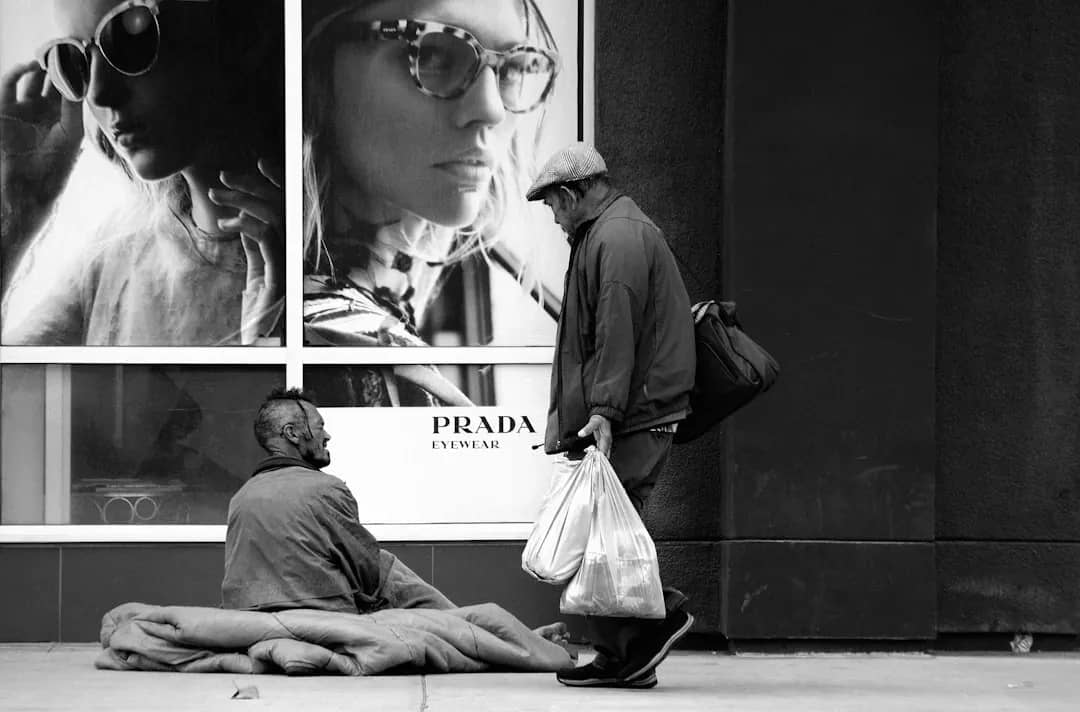
Poverty Serves Spectators
In a striking exploration of societal roles, the article unveils the unexpected 'functions' of homelessness. As a mirror to our own lives, the homeless serve as contrast providers, charity recipients, and cautionary tales. They even justify service economies and test survival gear, all while remaining unseen contributors to society's fabric.
You asked what value a homeless person provides. What function they serve. You wanted itemized utility, fifteen ways the destitute justify their existence to those who aren't.
I'll answer, but not the way you expected.
The homeless person serves primarily as measurement device. You see him on the street and calculate upward distance. You earn middling income, struggle with rent, feel economic pressure monthly. Then you pass someone sleeping in a doorway and suddenly you're elevated. Not through your own improvement, through his degradation. Happiness isn't absolute wealth. It's comparative poverty. Studies confirm this. Humans feel satisfaction not from what they possess but from observing others possess less.
This is the first function, contrast provider. You need him poor so you can feel rich.
Second function, recipient for your charity. You want to give. Giving makes you feel generous, moral, participating in social good. But you need someone positioned below you to receive. He serves this role. Doesn't matter that he'll probably spend your five euros on alcohol or gambling. What matters is the transaction gave you the sensation of benevolence. You performed generosity. He enabled the performance by being appropriately wretched.
Each person plays their role. Yours currently is reading my letters from your warm home in London or New York. His is being visible poverty. Next incarnation maybe you switch positions. For now, this is the distribution.
Third function, cautionary evidence. Looking at him, you tell yourself "could happen to anyone" while simultaneously believing it couldn't happen to you. You need him to represent consequences, lost job, lost wife, lost stability, descent into substances, ending in the street. This confirms your choices were correct. You stayed employed, stayed married, stayed housed. His failure validates your success. Though you also tell yourself he deserves it. He made errors. Poor decisions. Weak character. Otherwise he wouldn't be there.
The homeless also fund entire service economies. Social housing, shelters, intervention programs, all require poverty to justify their budgets and employment. Without homeless populations, thousands of social workers, shelter operators, nonprofit administrators lose their function. He's not just recipient of services, he's justification for the infrastructure.
Product tester. Who better to evaluate sleeping bags, tents, winter gear? If he's using specific brands during winter, those brands work. Not camping equipment for weekend hobbyists, survival equipment for continuous use. If homeless populations documented which products actually function in sustained outdoor living, that information would have value. Someone would pay for that expertise. Mostly doesn't happen. The knowledge exists, gets used, never converts to income for the person who generated it.
Street performer. Some provide ambient music. Terrible music usually, off-key singing, aggressive percussion on buckets. Sometimes you pay them to stop. Silence becomes the product. They understand this. Noise first, then payment for cessation.
Urban philosopher. They have time to think. Time produces contemplation. Some develop theories about society, politics, cosmic meaning. Whether these theories have value is separate from whether they exist. They exist. They'll discuss them if you engage. Most conversations aim toward eventual donation, not purely transactional but clearly motivated by financial hope.
They demonstrate generosity sometimes. Not all of them. But observing mutual aid among people who have almost nothing provides contrast against middle-class resource hoarding. Two homeless people sharing food when both are hungry, that registers differently than wealthy people donating surplus they never needed.
They share diseases. Tuberculosis, plague reemerging. Bad breath, body odor, infections spreading through proximity. You'd prefer they didn't, but they do. This isn't utility. This is cost.
Social connection. Elderly people without family sometimes talk to homeless individuals, breaking urban isolation. The homeless person provides conversation, presence, human interaction for those who lack it. Again, not free service, they're hoping for money, but they'll talk first and only suggest payment through implication.
Artistic output. Many claim talent. Usually they're wrong. Mediocre musicians, amateur painters, unpublished poets who insist they're undiscovered geniuses waiting for recognition they haven't pursued. They don't submit work to galleries, contact producers, build online presence. They expect discovery without exposure. This rarely works. I make webs and app's and write letters, get customers response, measure my reach, ten thousand followers. Not a hundred thousand. Not a million. Modest success. Mediocre success. The success I've earned through actual output and distribution, not through waiting for someone to notice my hidden brilliance.
They model alternative living. Exist outside social convention, own almost nothing, survive on minimal resources. Voluntary minimalism interests people, I practice it myself, though mine is chosen abundance restriction, not poverty. Involuntary minimalism, constrained survival, that's different but potentially instructive. How to live on fifty euros monthly. What matters when you own three items total. Which systems can be circumvented, which can't.
They suffer from cold. Every winter, bodies are found frozen on streets in cities that call themselves civilized, modern, wealthy. Emergency services collect corpses each January. This doesn't happen in Southeast Asia, no winter, therefore no freezing deaths. But Paris, London, other European capitals, routine winter mortality among homeless populations. You'd think societies with this much wealth would prevent this. They don't. They allow it. Maybe require it. Maybe the visible consequence, "fail to maintain housing and you'll freeze", serves function too. Motivation through fear.
I'm listing these not because I think they justify homelessness. I'm listing them because you asked what value they provide, and value gets measured by those observing from above. Every function I've named serves the housed, the employed, the stable. Nothing I've described serves the homeless person himself.
He exists primarily as object in other people's calculations. Contrast mechanism. Charity recipient. Product tester. Cautionary tale. Economic justification for service programs. Street entertainment. Philosophical discussion partner. Demonstration of resilience or failure depending on observer preference.
You wanted utility accounting. I've provided it. Fifteen functions, maybe more. All of them defined by people who aren't him, measuring how his condition benefits their experience, their economics, their emotional state.
The question itself reveals the framework. "What value does a homeless person add?" Only gets asked by someone positioned above, looking down, wondering if the person below justifies the space they occupy.
You live in beach clubs. Swim in infinity pools. Work from locations you'd recognize from travel magazines. He sleeps in doorways. Owns nothing. We all exist in the same economic system.
You generates content and comfort. His generates the contrast that makes yours feel earned.
Whispers live here
Words linger longer when they come from the heart.