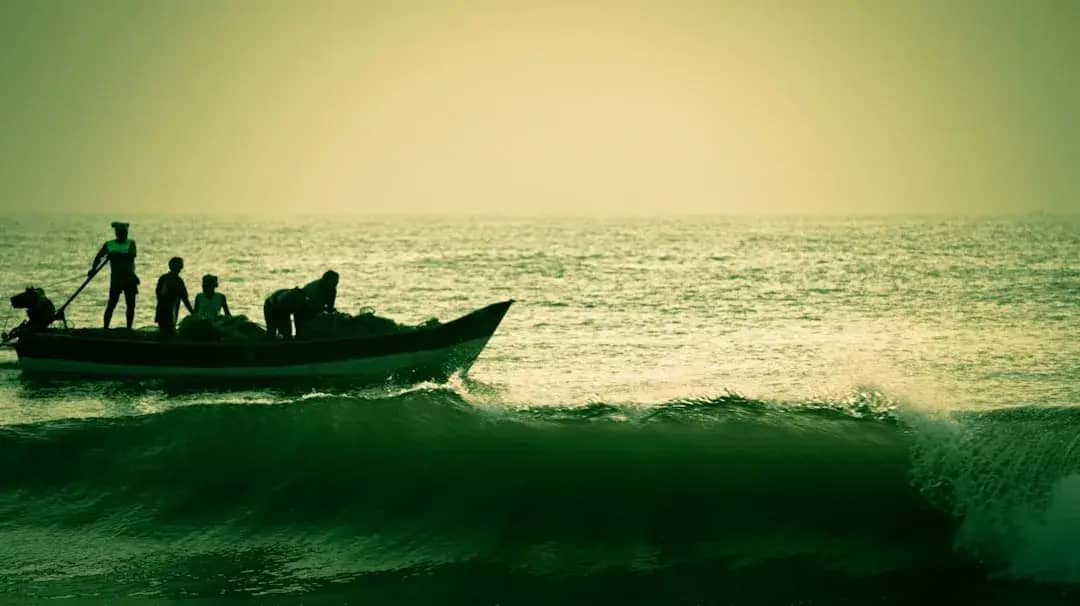
The Crossing
The silent chill of the Mediterranean night, the haraga embarks on a perilous journey. Driven by calculated reasoning rather than desperation, this crossing is a testament to the human spirit's relentless pursuit of a better life. Explore the untold arithmetic of hope versus certainty, where every decision is a gamble informed by the harsh realities and numbers.
There is a word in Algerian Arabic - Haraga - that means, literally, to burn. As in, to burn your papers. As in, to burn the trail behind you so the state cannot follow. As in, to burn your own biography and swim toward something that has no name yet, only a direction, only the cold of the Mediterranean at 3 AM and the particular silence of a zodiac boat carrying twenty-three people who have decided that the probability of drowning is preferable to the certainty of staying.
I have been thinking about this word for years.
What strikes me, what has always struck me, and what I confess I looked away from for too long, is that the haragas are not desperate. That is the version that makes the bodies easier to process politically. They are calculating. They have run the numbers the way any rational actor runs numbers, quietly, without drama, over months of observation, and they have concluded that the expected value of the crossing is higher than the expected value of remaining. This is not madness. This is arithmetic under conditions the people processing them in Italian detention centers will never personally face. And the most unsettling thing about watching someone make that calculation clearly, from where I stand, is how difficult it becomes to locate the error in their reasoning.
The Mediterranean has swallowed more than 28,000 people since 2014. That number is official, which means the real number is higher. States become conservative accountants when counting accurately becomes politically inconvenient.
But here is what the number conceals, for every one who drowned, there are between fifteen and twenty who made it. The haraga knows this ratio. He has cousins in Lyon, in Málaga, in the Milanese suburbs working construction for cash. He is not uninformed, he is precisely informed, which is a different thing entirely. The crossing is not a gamble in the sense of ignorance. It is a gamble in the sense of someone who has read the odds and decided the table is the only game available.
Algeria produces engineers, mathematicians, surgeons, people who could anchor any economy, and exports them as irregular migrants because the formal channel is architecturally designed to fail them. A Schengen visa application from Algiers requires proof of employment, proof of property, proof of funds, proof of a life substantial enough that you would never risk it. The geometry is airtight, only those with nothing to gain can qualify; only those who have already won are permitted to move. Everyone else burns.
European governments publicly condemn the crossings while continuing to depend economically on forms of labor their electorates prefer not to examine too closely. Algerian authorities export dissatisfaction, which is cheaper than addressing it. The haraga is, in this sense, the product of a bilateral arrangement that was never formalized, because formalization would have required honesty neither side could afford.
What disturbs me about myself, sitting in Algiers now, is how long I thought about all of this in the abstract. The policy architecture. The structural incentives. Clean and distant, like a white paper written by someone who sleeps well. Then a face becomes specific, a name becomes specific, and the architecture collapses into a person who was twenty-two years old and knew how to fix engines and decided one Tuesday that the sea was a more honest interlocutor than his government, and drowned somewhere between Annaba and Sardinia, and was counted or not counted in a statistic that will outlive everyone who loved him.
The question I cannot resolve, and I have stopped trying to resolve it, is what the correct emotional response is to a rational act that ends in death. Mourning implies waste. Admiration implies endorsement. Condemnation implies a comfort I have not earned. There is a kind of moral paralysis specific to witnessing a decision that is simultaneously free, logical, and fatal, and I suspect this paralysis is doing a great deal of political work in the countries that build the fences, because a paralyzed witness does not obstruct.
The demographic pressure from sub-Saharan Africa alone will deliver somewhere between 800 million and 1.2 billion additional young people to the labor market by 2050, in economies that cannot absorb them. The Mediterranean is not a border. It is a membrane. And membranes under sufficient pressure do not hold, they transform. The question of whether that transformation is managed or catastrophic will depend entirely on whether the people holding institutional power can think past the electoral cycle they are currently trying to survive. The record here is not encouraging.
The haraga burns his papers. What he is burning, though, is not just the document. He is burning the fiction that the document was ever protection. He is burning the social contract that was offered to him and honored in the breach. He is burning the idea that permission is required to move through a world he never chose to enter. The document is a lease, not a deed. He has understood this before the people who issued it were willing to admit it.
I do not romanticize the crossing. The water is cold and the operators are criminals and the probability of arriving is not one. I am saying something different. I am saying that a man who burns his papers has understood something about sovereignty that most people who hold passports have not had to understand. That in the end, the only thing that was ever truly his was the decision.
Whispers live here
Words linger longer when they come from the heart.