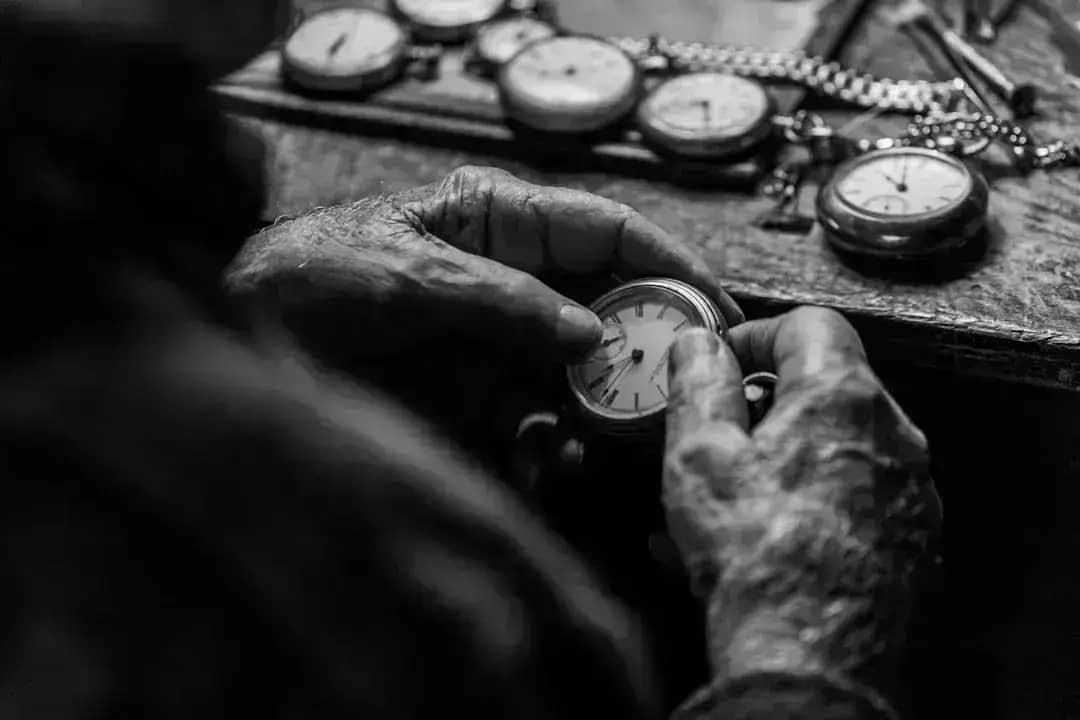
Archaeology of Urgency
Explore how time has transformed from a resource to a commodity, impacting our ability to live in the moment.
She had ninety-four years of dense time. You have forty of liquid time.
Your great-grandmother died at ninety-four without ever having run. She walked slowly, spoke deliberately, chewed each bite until it was like mush. She lived as if time were an inexhaustible resource because, for her, it was. There were no personal productivity metrics or algorithms for existential optimization. Duration was simply the air she breathed, invisible until it was gone.
You inherited the same lungs but a completely different kind of air. Time has become toxic, thick, scarce. Every second not used optimally is a second lost forever. You've turned duration into a commodity, and now you suffer the price fluctuations of your own most intimate resource.
This transformation is the result of forty years of social engineering that has colonized territories that for millennia remained outside the market. We have commodified sleep, gamified exercise, and quantified love. Now it was time to monetize duration itself.
The process works like this: First, they convince you that time is your most valuable asset. Second, they teach you techniques to "maximize your time efficiency." Third, you develop chronic anxiety about wasting time. Fourth, you buy products that promise to give you back your lost time. It's the perfect scam because it turns your very existence into the problem you need to solve.
Your great-grandmother didn't have this problem because she lived in a completely different temporal economy. Time was cyclical, seasonal, ritualistic. It moved in spirals, not straight lines toward deadlines. Days repeated with subtle variations. Seasons returned laden with accumulated meaning. Death was the natural horizon, not a project deadline.
We live in a linear, industrial, extractive world. Every moment must produce something quantifiable or it's considered wasted. We've applied factory logic to conscious experience, as if life were an assembly line where we process experiences to generate added value.
The result is a specifically modern pathology: the inability to be present without being productive. You've lost your great-grandmother's capacity to inhabit the moment without justifying it. For her, contemplating the clouds for an hour wasn't wasted time. It was time lived in its purest form.
A friend explains to me that his day is structured in thirty-minute blocks, allocated according to an algorithm that assesses impact, energy levels, and external conditions. He has eliminated improvisation from his life. His existence has become predictable, efficient, and utterly sterile. It's like living inside a spreadsheet.
She has achieved something your great-grandmother would consider a tragedy: a life without surprises. For her, the unexpected was where the joy of existence lay. Conversations that lingered because something important had to be said. Afternoons that slipped away because there was something beautiful to behold. Projects that were abandoned because something better to do appeared.
That ability to flow with what emerged required a fundamental trust in the abundance of time. Your great-grandmother intuitively knew she would have enough time for everything that truly mattered. Not because she was naive about mortality, but because she had learned to distinguish between the urgent and the essential.
You've lost that distinction. Everything has become urgent in an economy where time is artificially scarce. You've imported the logic of manufactured scarcity into your most intimate experience. Like someone rationing water on an island surrounded by ocean.
The paradox is that the more you manage your time, the less time you have. The energy you spend optimizing is energy you don't experience. The attention you dedicate to planning is attention you don't experience. You've become the manager of your own existence, and like any manager, you've lost direct contact with the product you're managing.
Your great-grandmother didn't manage her time because she inhabited it. The difference is physical. Managing requires distance, perspective, control. Inhabiting requires immersion, presence, commitment. They are two incompatible ways of relating to time.
She lived in a time that was dense, viscous, full of texture. You live in a time that is liquid, accelerated, slipping through your fingers as you try to grasp it. You have traded quality for speed. Intensity for efficiency. Depth for coverage.
This isn't nostalgia. It's a diagnosis. We've solved the problem of material survival and created the problem of temporal scarcity. We've conquered space and lost the concept of duration. Your great-grandmother was richer than you in the one resource that truly matters.
Time to do nothing productive. Time to be surprised. Time to change your mind mid-sentence.
Time for time.
Whispers live here
Words linger longer when they come from the heart.